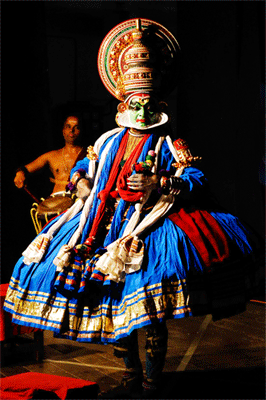
It is believed that the world famous art
form of Kerala, took birth in the land of Ganesa, Kottarakkara. Kathakali
took form in the seventeenth century. There are some legends behind its
origin.
One day Kottarakkara thampuran, requested the Zamorin of Kozhickode, Manaveda,
to send a team of Krishnanattam performers for a festival. But the Zamorin
sarcastically denied the request. This was an insult to the Thampuran. Kottarakkara
Thampuran went to the Ganapathy temple and pleaded for a way. Then on the
surface of his mind arose the plan to create a new art form. He sat on the
banks of the temple’s pond looking intothe water. There he saw different
shapes of waves in scintillating colour combinations. From this experience
Thampuran created the costume designs of Kathakali. He wrote Ramanattam
sitting beneath the banyan tree near the temple. Thus it was as a reply
to the Zamorin’s sarcasm that Thampuran created a new art form, Ramanattam.
This art form later developed into Kathakali.
.The people around Kottarakkara believed that Kathakali became famous with
the blessings of The Lord Ganapathy. The first staging of Ramanattam was
done in front of Ganesa. Today also Kathakali occupies a prominent position
in the programmes of the festival.
Some historians point out that Thampuran created the new art form from the
essence of a famous art form called Parappettam, which prevailed in the
land during his time.
Kathakali also shares a lot of similarities
with Krishnanattam, Koodiyattam (a classical Sanskrit drama existing in
Kerala) and Ashtapadiyattam (an adaptation of 12th-century musical called
Gitagovindam). It also incorporates several other elements from traditional
and ritualistic art forms like Mudiyettu, Thiyyattu, Theyyam and Padayani
besides a minor share of folk arts like Porattunatakam. All along, the martial
art of Kalarippayattu has influenced the body language of Kathakali. The
use of Malayalam, the local language (albeit as a mix of Sanskrit and Malayalam,
called Manipravalam), has also helped the literature of Kathakali sound
more transparent for the average audience. The characters with painted faces
and elaborate costumes besides advanced choreography (primarily developed
Kaplingad Narayanan Namboodiri - 1739-1789) to re-enact stories -- largely
from the Hindu epics. Kathakali has traditionally been performed in temples
and palaces, but over the past century it also finds venues in post-harvest
paddy fields and, since the last few decades, in proscenium stages of public
halls/auditoria and even in pagentry shows (in bits) of late.
Overall, what initially began as a rustic, uncivilised form gradually gained
exquisite looks, sophisticated movements and complementary audio support
to graduate itself as one of the world's most advanced dance-dramas today.